Beyond Front and Back
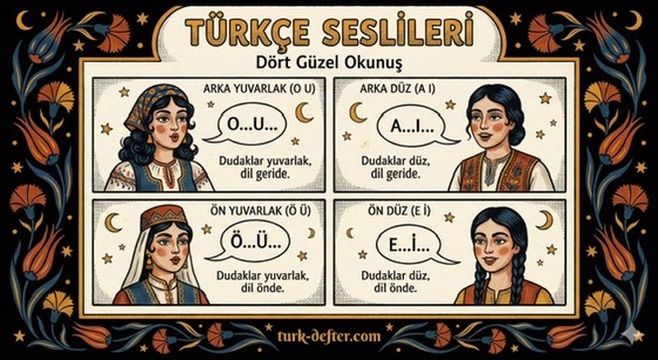
We’ve already seen that the eight vowels in Turkish fall into two main camps:
- Back vowels: a, ı, o, u
- Front vowels: e, i, ö, ü
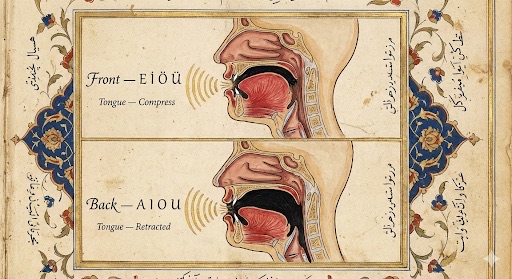
But Turkish doesn’t stop there. Each of these groups splits again, based on what your lips are doing.
Rounded and Unrounded Vowels
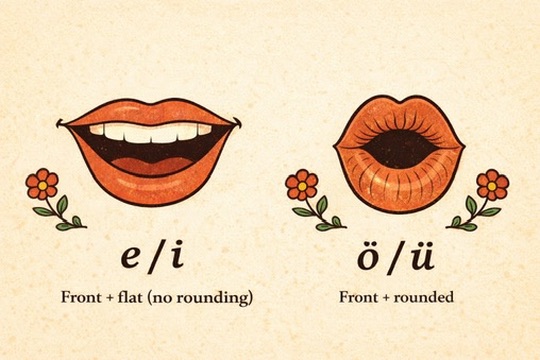
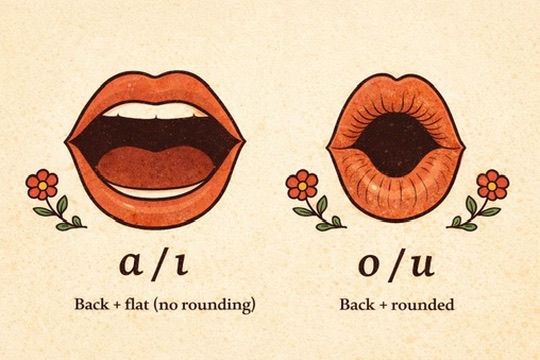
This part is refreshingly literal. The question is simple: are your lips rounded when you pronounce the vowel, or not?
That gives us four neat, symmetrical groups. We can visualize this as a 2×2 system:
| Unrounded (Flat Lips) | Rounded (Round Lips) | |
|---|---|---|
| Back | a, ı | o, u |
| Front | e, i | ö, ü |
This system is the backbone of Turkish vowel harmony.
The Question Particle: mi / mı / mu / mü
The Turkish yes/no question particle doesn’t have a single fixed form. Instead, it changes to match the final vowel of the word it follows.
The rule is simple: Look at the last vowel of the word.
- If it’s a or ı → use mı
- If it’s o or u → use mu
- If it’s e or i → use mi
- If it’s ö or ü → use mü
A few examples. Notice how the particle simply “echoes” the vowel before it:
- Bu araba mı? (Is this a car?)
- Hazır mı? (Is it ready?)
- Soğuk mu? (Is it cold?)
- Güzel mi? (Is it beautiful?)
- Üzgün mü? (Is he/she sad?)
Once you see this as a small, closed system rather than four unrelated forms, the question particle stops feeling arbitrary and starts feeling inevitable.
Quiz Yourself
Click / tap on the cloze item to reveal the answer. See if you can figure out what question particle each question gets:
- Bu araba ? (Is this a car?)
- O üzgün ? (Is he sad?)
- Bu doktor ? (Is this a doctor?)
- Bu kedi ? (Is this a cat?)
- Çorba soğuk ? (Is the soup cold?)
- Hava sıcak ? (Is the weather hot?)
- Şarkıcı ünlü ? (Is the singer famous?)
- Yemek lezzetli ? (Is the food delicious?)
- Kutu dolu ? (Is the box full?)
- Kapı kapalı ? (Is the door closed?)
- Bu süt ? (Is this milk?)
- O öğretmen ? (Is she a teacher?)
- Bu doğru ? (Is this correct?)
- Anahtar burada ? (Is the key here?)
- Ev küçük ? (Is the house small?)
- İşler iyi ? (Are things good?)
- Yol uzun ? (Is the road long?)
- O haklı ? (Is he right?)
- O müdür ? (Is he the manager?)
- Senin evin yeni ? (Is your house new?)
- Hava güneşli ? (Is the weather sunny?)
- Bu köprü ? (Is this a bridge?)
- O yorgun ? (Is he tired?)
- Sınav zor ? (Is the exam difficult?)
- Bardak boş ? (Is the cup empty?)
- Yemek tuzlu ? (Is the food salty?)
- Bu balık ? (Is this a fish?)
- O Türk ? (Is he Turkish?)
- Kapı açık ? (Is the door open?)
- Bu otobüs ? (Is this a bus?)
- Sen öğrenci ? (Are you a student?)
- Su soğuk ? (Is the water cold?)
- O güçlü ? (Is he strong?)
- Bu elma ? (Is this an apple?)
- Araba hızlı ? (Is the car fast?)
- O zengin ? (Is he rich?)
- Bu yüzük ? (Is this a ring?)
- Çanta ağır ? (Is the bag heavy?)
- Problem büyük ? (Is the problem big?)
- O evli ? (Is she married?)