
In Turkish, the present continuous tense (-iyor) is the workhorse of the language. While we use it for what is happening “right now,” it also handles habits and firm future plans. Think of it as the default “active” state.
The Vowel Harmony Logic
The suffix -yor is fixed, but the “buffer” vowel preceding it must satisfy 4-way vowel harmony
| Last Vowel in Stem | Suffix to Add | Example |
|---|---|---|
| a, ı | -ıyor | bak (look) → bakıyor |
| e, i | -iyor | gel (come) → geliyor |
| o, u | -uyor | koş (run) → koşuyor |
| ö, ü | -üyor | gül (laugh) → gülüyor |
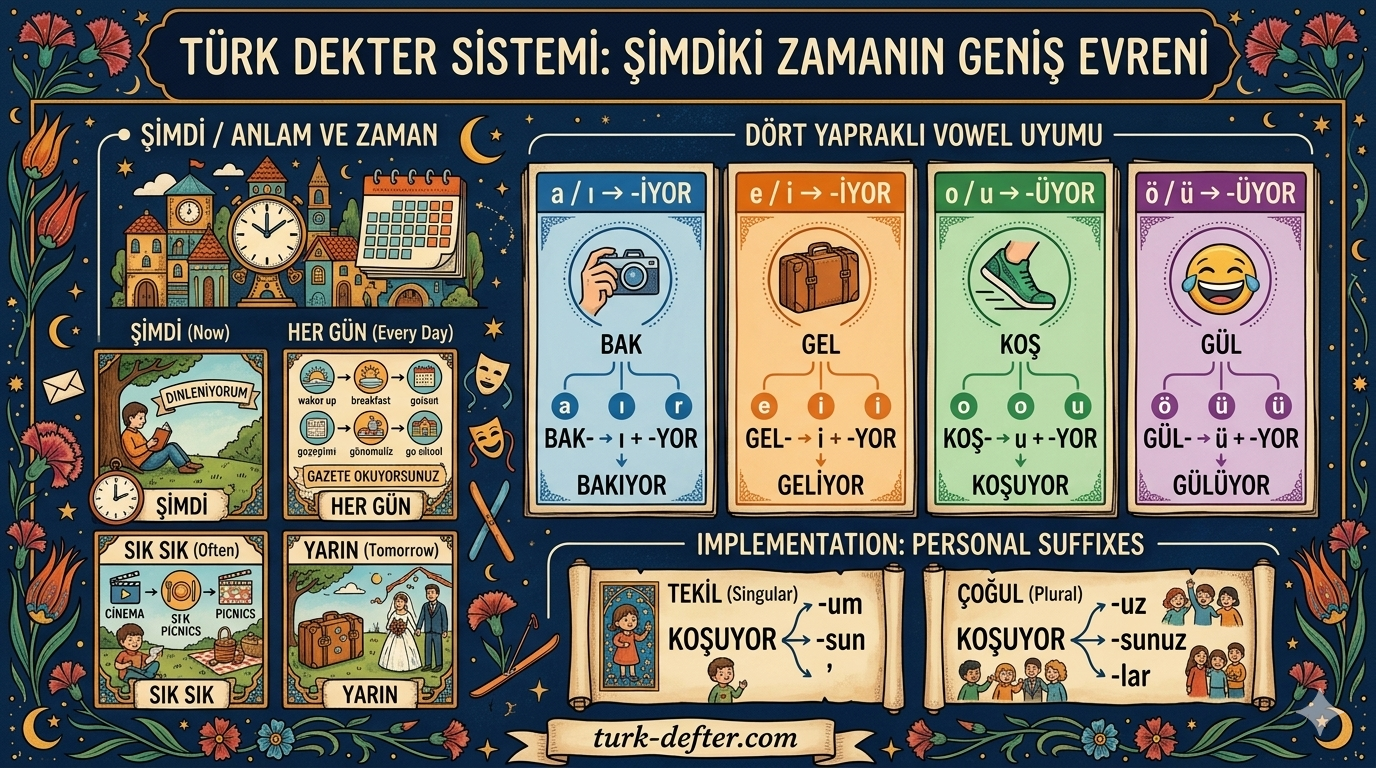
Present tense graphic.
Implementation: 22 Sentences
Here is a breakdown of the present continuous in action, ranging from immediate actions to habitual routines and future intent.
| # | Turkish Sentence | English Translation |
|---|---|---|
| 1 | Ben şimdi dinleniyorum. | I am resting now. |
| 2 | Sen şimdi gazete okuyorsun. | You are reading a newspaper now. |
| 3 | O şimdi mektup yazıyor. | He/She is writing a letter now. |
| 4 | Biz şimdi ders çalışıyoruz. | We are studying now. |
| 5 | Siz şimdi havuzda yüzüyorsunuz. | You (pl) are swimming in the pool now. |
| 6 | Onlar şimdi tenis oynayorlar. | They are playing tennis now. |
| 7 | Ben her gün televizyon seyrediyorum. | I watch television every day. |
| 8 | Sen her sabah kahvaltıda çay içiyorsun. | You drink tea at breakfast every morning. |
| 9 | O her yıl tatilde bu otelde kalıyor. | He/She stays at this hotel every year on holiday. |
| 10 | Biz her ay tiyatroya gidiyoruz. | We go to the theater every month. |
| 11 | Siz her kış kayak yapıyorsunuz. | You (pl) ski every winter. |
| 12 | Onlar her sabah spor yapıyorlar. | They do sports every morning. |
| 13 | Ben genellikle her sabah kahve içiyorum. | I usually drink coffee every morning. |
| 14 | Sen sık sık sinemaya gidiyorsun. | You go to the cinema often. |
| 15 | O sık sık yalan söylüyor. | He/She often tells lies. |
| 16 | Biz genellikle hafta sonunda evde kalıyoruz. | We usually stay at home at the weekend. |
| 17 | Siz sık sık bu lokantada öğle yemeği yeyorsunuz. | You (pl) often eat lunch in this restaurant. |
| 18 | Onlar genellikle burada piknik yapıyorlar. | They usually have a picnic here. |
| 19 | Ben yarın tatile çıkıyorum. | I am going on holiday tomorrow. |
| 20 | O gelecek ay evleniyor. | He/She is getting married next month. |
| 21 | Biz yarın geliyoruz. | We are coming tomorrow. |
| 22 | Siz her gün gazete okuyorsunuz. | You (pl) read the newspaper every day. |
Debugging the Edge Cases
When building these sentences, keep an eye on these three common “runtime errors”:
- Vowel Narrowing: If a verb ends in
-aor-e(like oyna- or söyle-), that vowel drops or changes before adding-iyor. - Consonant Mutation: For specific verbs like git- (to go) and et- (to do), the
tsoftens to adwhen the vowel suffix hits it (gidiyor, ediyor). - The “Ye” Exception: The verb ye- (to eat) narrows its vowel to an
i, becoming yiyor.
Trigger Phrases
The following keywords are strong indicators that you should be using the -iyor suffix:
| Turkish | English | Example from Worksheet |
|---|---|---|
| Şimdi | Now | Ben şimdi dinleniyorum. |
| Şu an | At the moment | (Not in list, but very common) |
| Her gün | Every day | Siz her gün gazete okuyorsunuz. |
| Her sabah | Every morning | Onlar her sabah spor yapıyorlar. |
| Her ay | Every month | Biz her ay tiyatroya gidiyoruz. |
| Genellikle | Generally / Usually | Biz genellikle evde kalıyoruz. |
| Sık sık | Often | Sen sık sık sinemaya gidiyorsun. |
| Yarın | Tomorrow | Ben yarın tatile çıkıyorum. |
| Gelecek ay | Next month | O gelecek ay evleniyor. |
| Gelecek yıl | Next year | (Used for distant but certain plans) |